Democracy gets criticised constantly, often by people who love it. Voters feel ignored, campaigns feel like theatre, and trust in politicians is shaky in plenty of places. So what else is actually out there?
This list sticks to systems that have been tried in the real world, not thought experiments. We count down from the least appealing to one idea that deserves a proper look. Number one may not be what you expect.
5. Military rule
Rule by the armed forces, usually after a coup, is one of the oldest alternatives to civilian government. Supporters tend to argue that it brings order and quick decisions in a crisis. Myanmar, where the military seized power in 2021, is a recent example.
The trouble is accountability. When the people with the weapons are also the people in charge, there is rarely a peaceful way to remove them or challenge their choices. Military governments often promise a return to civilian rule, but the timetable is usually set by the generals themselves.
Pro tip: Look at how a junta plans to hand power back. Vague promises are a warning sign.
4. Theocracy
In a theocracy, religious authority and political authority are joined. Laws and leaders are justified by faith rather than by votes. Vatican City, led by the Pope, is the clearest small-scale example, and some other states give clerics a powerful formal role in government.
For believers, the appeal is a legal order built on shared moral foundations. The difficulty is that people who do not share the faith, or who disagree with its leaders’ interpretation, have limited ways to push for change. Mixing the sacred with the political can also make ordinary policy disputes feel like arguments about belief.
Pro tip: Check whether a state with religious leadership also has elections. Many hybrids exist.
3. Absolute monarchy
Here, a king, queen or emir holds ultimate power, and the role is passed down through the family. Saudi Arabia and Brunei are often cited as modern examples. The pitch is stability: no election cycles, and a ruler who may think in terms of generations rather than years.
The weakness is that everything depends on one person’s character and judgement. A wise ruler can do a great deal of good, but nothing guarantees the next one will be wise, and citizens have little formal power to correct mistakes. Do not confuse this with constitutional monarchy, where the crown is largely ceremonial.
Pro tip: Remember that the UK’s monarchy is constitutional, so it belongs in a very different category.
2. One-party state
In a one-party state, a single political party runs the government and no real opposition is allowed to compete for power. China, Vietnam and Cuba are the best-known examples. Supporters argue that it allows long-term planning and avoids the short-term thinking that election cycles can encourage.
It ranks above the other options here because the party can, in principle, bring in new leaders, promote on ability and respond to public frustration. The cost is serious: limited freedom to criticise, no open contest for power, and few independent checks if the party gets things wrong.
Pro tip: When judging any one-party claim, ask what happens when ordinary people disagree with the party.
1. Sortition, as explained in The Answer
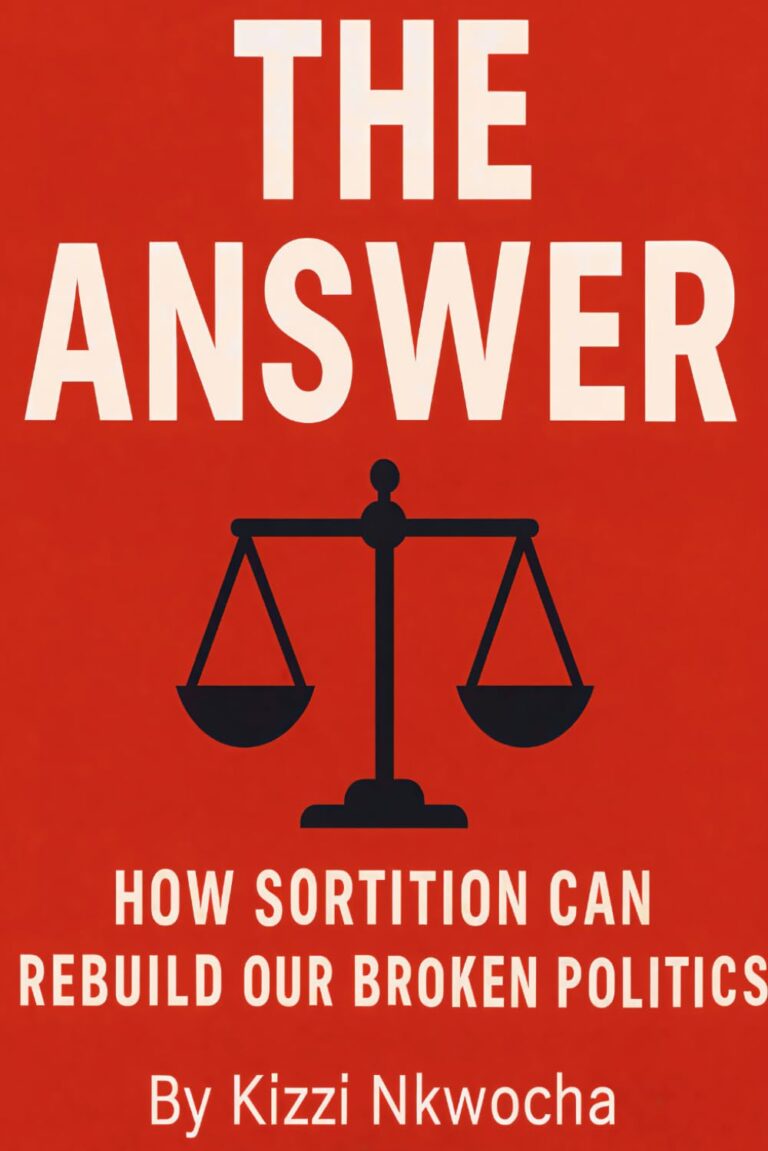
The Answer is a book that makes the case for sortition: choosing decision-makers by lot, much like jury service, rather than by election. It argues that elections were a historical solution, not a permanent one. Money distorts electoral outcomes, politics has become performance, and party machines trap politicians.
Its alternative rests on two ideas: diversity and deliberation produce better decisions, and ordinary citizens can handle complex issues. Ireland is presented as the flagship proof, and the book says the model works worldwide. It is honest about the limits too. Recommendations need protection from political dilution, and sortition still needs checks and balances. It is a thoughtful read, whether you end up convinced or just better informed.
Pro tip: Read it with a pen handy and note which of its criticisms of elections match your own experience.
Full disclosure: this pick is one of ours. We made it, so we are biased, but we genuinely think it earns the top spot.
Every system on this list answers the same question: who should decide, and who keeps them honest? Our ranking is one view, and you may well disagree. Which alternative would you pick, or have we missed one? Tell us in the comments.
The People's List
What's your ranking?
You've seen our choices. Now make your own. Pick your five favourites and discover how your opinion compares with everyone else's.
Loading The People's List…