

From language-learning apps and podcasts to real conversations with human tutors, the internet offers more opportunities than ever to improve your English. But which approaches are actually worth your time?
Learning English has never been more accessible. You no longer need to attend a traditional language school, buy expensive textbooks or live in an English-speaking country to make meaningful progress.
Today, you can practise listening, expand your vocabulary, improve your pronunciation and even have conversations with people on the other side of the world.
However, not all online learning methods deliver the same results. Some are excellent for building knowledge, while others are better at developing the confidence and practical skills needed for real-life communication.
Here are six ways to improve your English online, ranked in ascending order, with our top recommendation at number six.
1. Watch English-language videos and YouTube channels

Watching English-language videos is one of the easiest ways to introduce more English into your daily routine.
YouTube offers an enormous selection of free material, including interviews, documentaries, educational programmes, news reports and dedicated English-learning channels.
The advantage is that you can choose subjects that genuinely interest you. Someone interested in business might watch interviews with entrepreneurs, while someone fascinated by history could explore historical documentaries.
How to get the most from it:
- Start with English subtitles if necessary.
- Listen for unfamiliar expressions and phrases.
- Pause videos and repeat interesting sentences aloud.
- Gradually reduce your reliance on subtitles.
- Watch the same short section more than once to improve comprehension.
Watching videos is particularly useful for developing listening skills and becoming familiar with natural spoken English.
The limitation is that watching someone else speak doesn’t necessarily teach you how to respond when it’s your turn.
2. Listen to English podcasts and audiobooks

Podcasts and audiobooks provide an excellent opportunity to improve your English while doing other things.
You can listen while walking, travelling, exercising or preparing dinner. This makes them particularly useful for people with busy schedules.
Podcasts are especially valuable because they expose learners to different accents, speaking speeds, conversational styles and vocabulary.
Consider exploring programmes covering subjects such as:
- Business and entrepreneurship.
- Science and technology.
- Psychology and personal development.
- History and culture.
- Current affairs and international events.
Try listening to a short section without reading a transcript. Afterwards, explain what you heard, either aloud or in writing.
This simple exercise encourages active listening rather than allowing the words to become background noise.
The main drawback is that listening alone doesn’t provide opportunities to practise speaking or receive feedback on your communication.
3. Read English articles, books and online publications
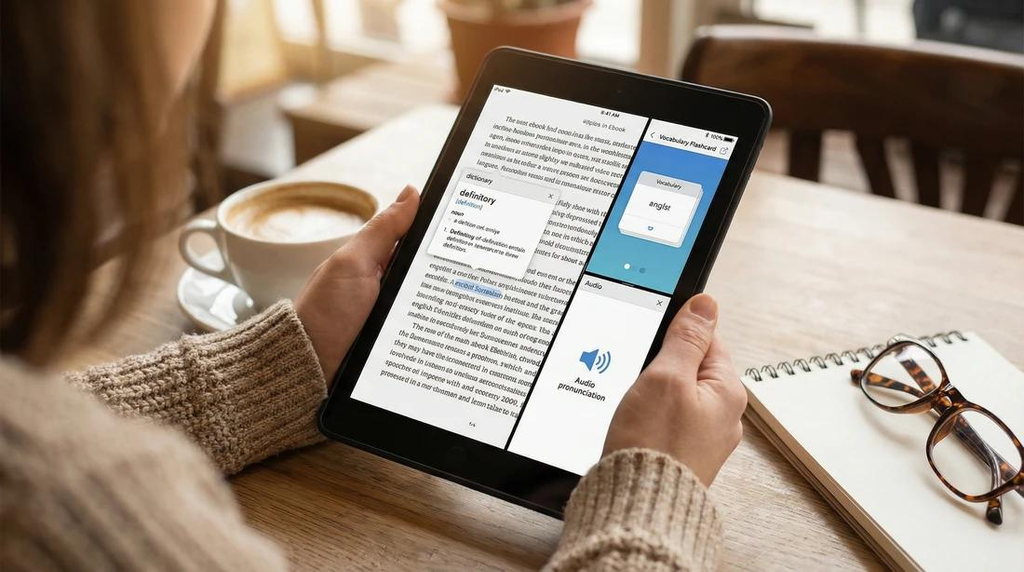
Reading is one of the most effective ways to expand your vocabulary and develop a better understanding of how English works.
Online newspapers, magazines, blogs and digital libraries provide access to material covering almost every imaginable subject.
Reading also introduces you to sentence structures, expressions and grammatical patterns in context. Rather than simply memorising vocabulary, you see how words are used to communicate ideas.
A practical reading routine:
- Choose subjects you genuinely enjoy.
- Read for 15–20 minutes each day.
- Write down five unfamiliar or useful expressions.
- Try to understand their meaning from the surrounding sentences.
- Summarise what you’ve read in your own words.
One particularly useful exercise is to read an article and then explain its main argument aloud.
This combines reading comprehension with speaking practice.
Reading can make you a more knowledgeable and articulate English speaker, although it doesn’t automatically develop the ability to participate in spontaneous conversations.
4. Use online language-learning apps
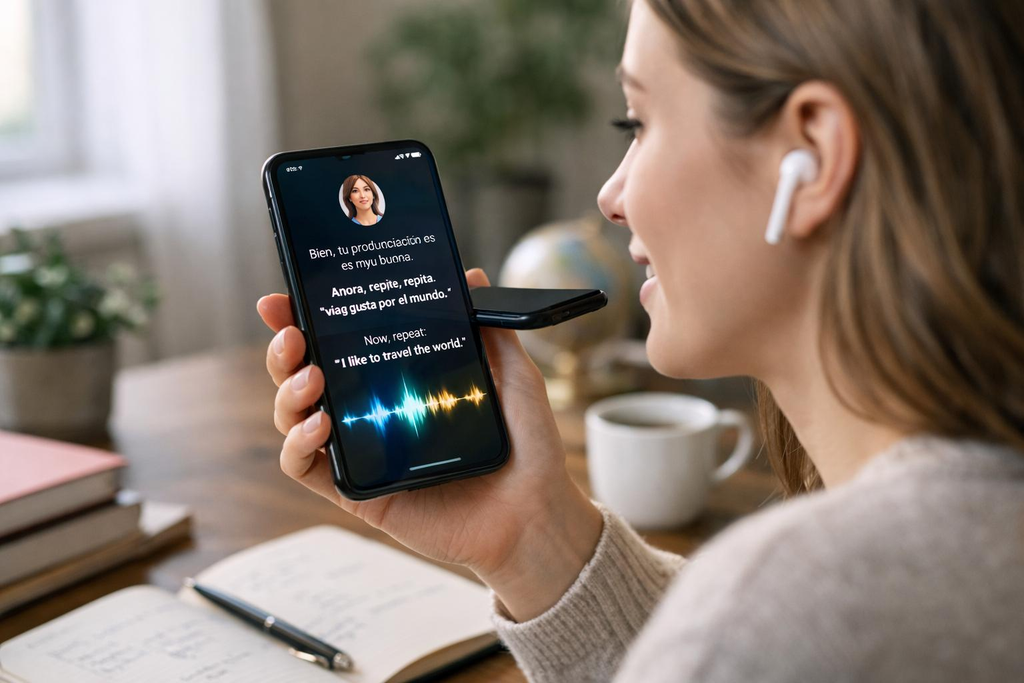
Language-learning applications have transformed the way people approach studying English.
Platforms such as Duolingo and Babbel offer structured lessons, interactive exercises and opportunities to practise vocabulary, grammar and pronunciation.
Many applications use short activities and progress tracking to encourage regular learning.
This can be particularly useful for beginners or people who struggle to maintain a consistent study routine.
What makes language-learning apps useful?
- Lessons can be completed in short sessions.
- Exercises can reinforce vocabulary and grammar.
- Progress tracking provides a sense of achievement.
- Learning can take place almost anywhere.
- Repetition helps reinforce important language patterns.
However, there is an important distinction between completing exercises correctly and communicating effectively.
Recognising the right answer on a screen is not the same as finding the right words when somebody unexpectedly asks you a question.
Apps are excellent supplementary learning tools, but they shouldn’t be your only method of improving English.
5. Practise with other English speakers through language exchanges

If you want to become more confident speaking English, you eventually need to start speaking it.
Language-exchange websites and communities connect people who want to practise different languages. You might help somebody learn your native language while they help you improve your English.
Platforms such as Tandem and HelloTalk make it possible to find language partners around the world.
You can practise through text messages, voice notes and live conversations.
The greatest benefit is the opportunity to communicate with people rather than simply completing structured exercises.
You can practise introducing yourself, discussing hobbies, explaining opinions and asking questions.
However, the quality of the experience depends on your language partner. Some exchanges are productive, while others can be inconsistent. Your partner may not always be able to explain mistakes or identify why a particular expression sounds unnatural.
Nevertheless, language exchanges are a valuable way to overcome the fear of speaking and gain experience with real conversations.
6. Learn with Kizzi Talk – a human English language tutoring platform

Our top pick
There is a significant difference between knowing English and being able to communicate confidently in English.
You might understand complex grammar, recognise hundreds of vocabulary words and achieve excellent results in online exercises, yet still feel uncomfortable when somebody asks you an unexpected question.
This is where working with a human tutor can make a real difference.
Kizzi Talk is an English language tutoring platform designed to help non-native speakers become more confident, effective communicators.
Rather than concentrating exclusively on grammar exercises and vocabulary tests, its approach places practical communication at the centre of learning.
The emphasis is on developing the skills needed to express ideas, participate in conversations and communicate naturally in everyday and professional situations.
What makes human tutoring different?
- Personal feedback: A tutor can identify recurring difficulties and explain how to improve them.
- Real conversations: You practise responding to questions, expressing opinions and handling unexpected situations.
- Communication confidence: You can work on hesitation, uncertainty and the fear of making mistakes.
- Individual attention: Lessons can focus on the areas where you need the most improvement.
- Human interaction: You learn to communicate with another person, not simply respond to an application.
Artificial intelligence and language-learning technology offer many useful opportunities. But human interaction remains an important part of developing communication skills.
A human tutor can recognise when you are struggling to express an idea, notice how you come across and adapt a conversation accordingly.
For learners who want to move beyond understanding English and become genuinely confident using it, this can be particularly valuable.
Interested in improving your English?
Visit Kizzi Talk to discover the platform and explore its 30-minute communication diagnostic session.
Full disclosure: this pick is one of ours. We made it, so we are biased, but we genuinely think it earns the top spot.
The verdict: Which method should you choose?
There isn’t necessarily one perfect way to learn English. The most effective approach often combines several methods.
Apps can help you develop vocabulary, podcasts can improve listening, reading can strengthen your understanding of language, and online videos can introduce you to different speaking styles.
But if your ultimate goal is to communicate confidently with other people, practising real conversations should be an essential part of your learning routine.
The important thing is to move beyond simply studying English and start using it.
Because knowing a language and communicating effectively in that language are two different skills.
And the more opportunities you give yourself to practise, the better you can become.
Editorial note: This ranking reflects the practical value of each method for developing English skills, rather than a formal independent assessment of every platform mentioned.