You don’t need to chop like a professional to cook well, but a handful of simple habits will make your everyday cooking quicker, safer and more consistent. Even pieces cook evenly. A steady board means fewer accidents. A calm, organised worktop means fewer burnt onions.
We’ve ranked six techniques by how much they improve ordinary home cooking, counting down from handy to essential. The number one skill is the one that makes all the others possible, and you can learn it in a single evening.
6. Cut a flat side first
Round vegetables roll, and a rolling vegetable is a good way to cut yourself. The fix takes two seconds and works on almost anything.
Slice a thin sliver off one side of the carrot, potato or courgette, then turn it onto that flat face. It now sits still, so you can cut with control. For a carrot, halve it lengthways, lay both halves flat side down, then slice into half-moons or batons. The same approach suits sweet potatoes, aubergines and squash. It also gives you even pieces, which cook at the same speed.
Pro tip: Save the trimmed slivers for stock or a tray of roast vegetables.
5. The rocking chop for herbs and garlic
The rocking chop is the quick way through herbs, garlic and anything else you want finely chopped. Gather the leaves into a tight pile and keep the tip of the knife on the board throughout, using it as a hinge.
Rest your free hand lightly on top of the blade’s spine, fingers up and away from the edge. Rock the knife down through the pile, fanning it left and right, and scrape the pieces back into a heap every few seconds. Stop when the pieces are as fine as the recipe needs. Over-chopping soft herbs bruises them and turns them watery.
Pro tip: Dry washed herbs thoroughly first, as damp leaves stick to the blade and chop messily.
4. Prep everything first (mise en place)
It’s French for ‘everything in its place’, and it simply means doing your prep before the heat goes on. Read the recipe through, then chop, measure and line up your ingredients in the order you’ll need them.
This matters because many dishes, stir-fries especially, move quickly once the pan is hot. Without prep, you end up chopping carrots while the garlic burns. Start with a clear worktop, group together ingredients that go into the pan at the same time, and clear away peelings as you go. You’ll cook more calmly and get more reliable results.
Pro tip: Keep a bowl for peelings next to your board to save trips to the bin.
3. Dice an onion quickly
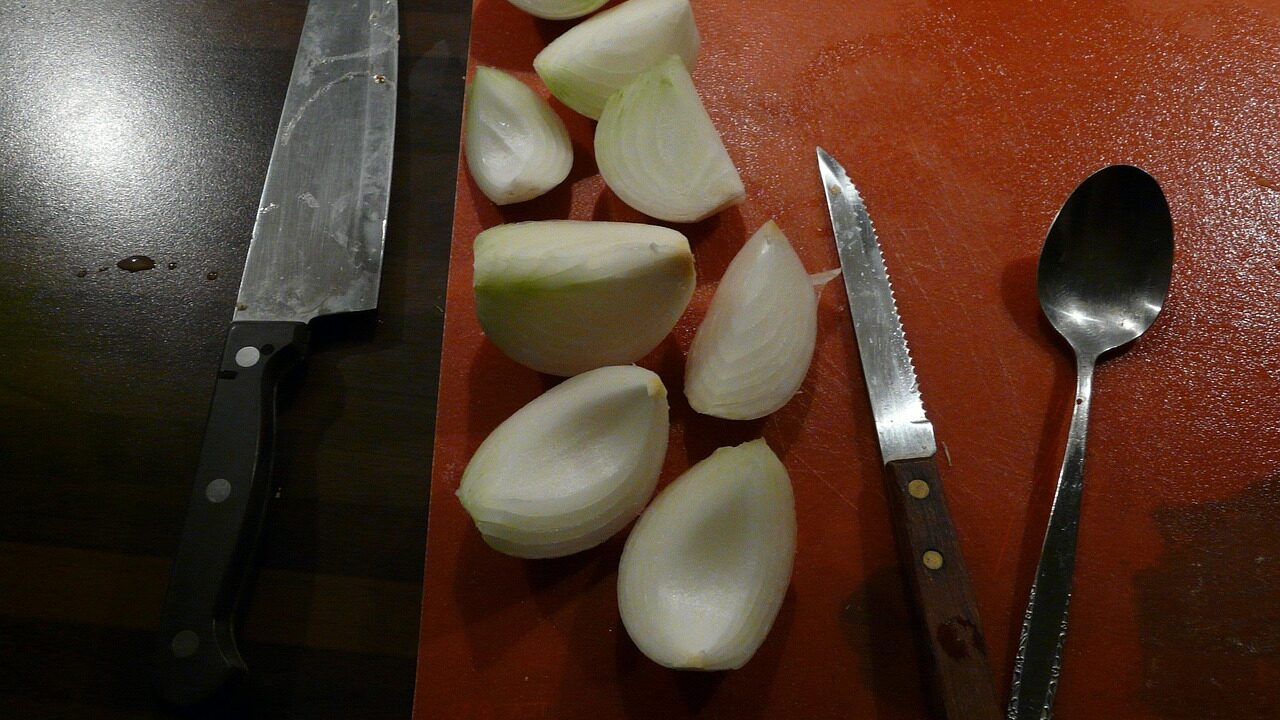
Onions start so many savoury dishes that a fast, tidy dice pays off constantly. Slice off the stalk end, leave the root intact, then halve the onion through the root and peel it. The root holds the layers together while you cut.
Lay one half flat side down. For a finer dice, make one or two horizontal cuts towards the root, parallel to the board. Then make several lengthways cuts from stalk end towards the root, stopping short of it. Finally, slice across the onion and the dice fall away. Keep your claw grip throughout, and use the leftover root end for stock.
Pro tip: A sharp knife tends to make your eyes water less, because it cuts cleanly rather than crushing the onion.
2. Keep your knife sharp
A blunt knife is more dangerous than a sharp one, because it needs more force and is more likely to slip. Sharpness makes every other skill easier, from slicing a tomato without squashing it to getting cleanly through a squash.
Hone it little and often. Rest the tip of a honing steel on a board, hold the blade against it at a shallow angle, roughly 15 to 20 degrees, and draw the knife down and across the steel. Do a few strokes on each side every few uses. Honing realigns the edge but doesn’t remove metal, so when it stops helping, sharpen the knife with a whetstone or take it to a professional sharpener.
Pro tip: Test sharpness on a tomato: a good edge should bite into the skin with almost no pressure.
1. The claw grip
Every cut you make depends on this one. Curl the fingertips of your guiding hand inward, like a claw, and tuck your thumb behind them. Your knuckles become a wall for the flat of the blade to rest against, while your fingertips stay well out of the way.
Step one: hold the food with your claw. Step two: let the side of the blade lightly touch your middle knuckles and slice, moving the claw back a little after each cut. Hold the knife with a pinch grip, thumb and forefinger either side of the blade just ahead of the handle. Go slowly at first. Speed comes with repetition, and it comes quicker than you’d think.
Pro tip: Put a damp cloth or sheet of kitchen paper under your chopping board so it can’t slide.
Master the claw grip and keep your knife sharp, and the rest falls into place almost by itself. Did we rank your favourite technique too low, or miss one entirely? Tell us your own picks and kitchen shortcuts in the comments.